PB PRECISIONBLAST SURFACE & COATINGS CO. №/ SINCE 2008 — HOUSTON, TX Book a site visit
05 / 06

Concrete
surface prep.

Almost every concrete coating failure we get called out to investigate traces back to one thing — the slab was never properly profiled. Paint doesn't bond to smooth, sealed concrete. It bonds to a mechanically roughened surface with a controlled profile. Getting that profile right is what this service is.

Schedule a floor visit
09CSP profile grades
04mthMinimum cure before coating
75%RH threshold (typical)
99%Dust capture, HEPA rig
[ WHY IT MATTERS ]

Concrete isn't a single material — it's a composite of cement paste, aggregate, and pore structure. That pore structure is what makes concrete prep different from metal prep, and it's what makes moisture testing non-optional.

A slab that looks perfectly dry on top can be actively passing water vapor from below. That vapor has to go somewhere. If it can't escape up through a permeable surface, it builds pressure under any coating that gets applied — and eventually the coating blisters, peels, or delaminates from below. Most "failed" epoxy floors weren't bad epoxy. They were applied on slabs that were passing moisture the spec never accounted for.

The other half of the problem is surface profile. Raw concrete comes out of a form or a trowel with a surface that's either too smooth (power-troweled slabs) or contaminated by curing compounds, form release agents, laitance, or residual adhesive from previous flooring. A coating needs a mechanically roughened surface — often called a mechanical key — to grip. If you apply epoxy to a smooth, power-troweled slab without profiling it, adhesion is whatever the coating's own chemistry provides. Usually not much.

Correct prep solves both problems at once — it removes the surface contamination and creates the profile in a single mechanical operation. This page covers how we classify profiles, which method to use for which substrate condition, and how we test for moisture before recommending any coating.
[ ICRI CSP PROFILES ]

Ten profile grades,
defined by the International
Concrete Repair Institute.

ICRI publishes the industry-standard surface profile scale used on virtually every concrete coating spec in North America. CSP 1 is nearly smooth; CSP 9 is deeply grooved. Each coating manufacturer specifies a range — go below it and adhesion fails, go above it and the coating won't cover the peaks.

SMOOTH ← PROFILE DEPTH → COARSE
  • CSP 1 Near-flat · acid etch Carpet · tile adhesive
  • CSP 2 0.5 – 1 mm Thin-film sealers
  • CSP 3 1 – 1.5 mm Light epoxy · urethane
  • CSP 5 2 – 2.5 mm High-build systems
  • CSP 6 2.5 – 3 mm Cementitious urethane
  • CSP 7 3 – 4 mm Heavy-duty overlay
  • CSP 8 4 – 6 mm Repair mortar key
  • CSP 9 6+ mm Structural repair
DEFAULT FOR INDUSTRIAL CSP 3–5

Ninety percent of our industrial epoxy and urethane work is specified within this range. Wide enough for mechanical grip, shallow enough for the coating to cover.

FOOD & BEVERAGE CSP 4–6

Higher profiles are used to give cementitious urethane systems a mechanical lock that survives thermal shock cycling and washdown.

PARKING / TRAFFIC CSP 3–5

Balanced profile for membrane systems on parking decks. Must be deep enough for wear resistance but smooth enough for traffic coating thickness.

Confirming target CSP before we mobilize is part of every estimate. Coating manufacturers publish a required CSP range in their product data sheets. If you have a spec, send it — we'll blast to it. If you don't, we'll recommend a range based on the coating you plan to apply and the service environment.

[ METHODS ]

Five ways to profile
a concrete slab.

Shot blasting is our default for most jobs, but it isn't the right tool for every slab. Here's how we decide.

METHOD PROFILE SPEED BEST FOR LIMITS
Shot blasting Steel shot centrifugal
CSP 3–8 Very fast Warehouse floors, garage decks, most industrial slabs Leaves no ridges. Requires dust collection.
Scarifying Rotary cutter drum
CSP 6–9 Fast Heavy coating removal, thick overlays, deep contamination Aggressive — cuts grooves. Not for thin toppings.
Diamond grinding Multi-head planetary
CSP 1–3 Medium Smoothing, edge work, tight areas, light profile Low profile — not for high-build systems.
Hydro-demolition Ultra-high pressure water
CSP 5–9 Medium Removing deteriorated concrete, exposing rebar, chloride-laden slabs Very wet. Requires containment and drying time.
Acid etching Muriatic or phosphoric
CSP 1–3 Slow Light residential prep only — legacy method Inconsistent. Regulated waste. We don't recommend it for industrial work.
OUR DEFAULT

For 90% of the industrial work we do, shot blasting is the correct answer — it's fast, it produces a uniform profile across the slab, and it's the least dependent on operator technique. The blast rig travels at a controlled speed and produces a consistent CSP grade. Scarifying is used when we need to remove thick existing coatings or material; grinding handles edges and restricted areas that the blast rig can't reach; hydro-demolition comes out when structural concrete has to come off before new work goes on. Acid etching isn't a method we offer on industrial jobs — the results are inconsistent and the waste stream is regulated.

[ MOISTURE TESTING ]

Before any coating
goes on, we test.

Moisture vapor emission is the leading cause of concrete coating failure in the Houston area. There's no visual way to know if a slab is passing vapor — you have to test it. We test every slab before recommending a coating.

ASTM F2170

In-situ relative humidity

The current standard. A hole is drilled into the slab to 40% of its thickness, a sensor is inserted, and the probe is left in place for at least 72 hours. The final reading is the actual relative humidity inside the slab at the depth where moisture is migrating.

Typical coating threshold < 75% RH
Safe to coat Caution · moisture mitigation Do not coat
Test duration
72–96 hr
Drill depth
40% of slab thickness
Acceptable range
Varies by coating · usually < 75%
Cost
Included in job
ASTM F1869

Calcium chloride vapor emission

The legacy standard. A pre-weighed dish of calcium chloride is sealed under a plastic dome on the slab for 60–72 hours. The dish absorbs moisture vapor passing through the concrete; the weight gain is measured and reported as pounds of water per 1,000 square feet per 24 hours.

Typical coating threshold < 3 lb / 1000 sq ft / 24 hr
< 3 lb 3–5 lb > 5 lb
Test duration
60–72 hr
Sampling area
20 sq in per dish
Acceptable range
Varies by coating · usually < 3 lb
Note
Superseded by F2170 for many specs
MITIGATION / 01

Moisture vapor barrier

Two coats of a 100%-solids epoxy moisture barrier applied before the wear coat. Rated to resist up to 25 lb / 1000 sq ft. Adds material cost but is far cheaper than tearing out a failed floor later.

MITIGATION / 02

Cementitious urethane

Urethane cement systems tolerate much higher substrate moisture than epoxy — often up to 12 lb without a separate barrier. Preferred for food and beverage plants where thermal shock and moisture are both concerns.

MITIGATION / 03

Wait it out

If the slab is young — under 28 days — the moisture may simply be hydration water that will dissipate. For green slabs, waiting 4–6 months and re-testing is often the least expensive option. We'll say so if that's the case.

MITIGATION / 04

Do not coat

If F2170 readings exceed 90% or F1869 exceeds 8 lb, no coating system will hold long-term. The right answer is to fix the moisture source (drainage, vapor barrier under slab, dehumidification) before any floor work. We'll tell you this even though it costs us the job.

[ DUSTLESS VS STANDARD ]

Same profile,
different cleanup.

Standard shot blasting generates a large volume of fine concrete dust and steel shot fragments. On an empty warehouse slab in the middle of a renovation, that's manageable. On a working food production line, in an occupied hospital, or in a data center, it isn't.

Our dustless rig integrates HEPA H14 vacuum recovery directly with the blast head — dust is captured at the point of generation rather than dispersed into the air. Airborne particulate readings during dustless operation typically measure below 5% of the standard blast figures, which is what allows us to work in occupied spaces.

STANDARD BLAST DUSTLESS (HEPA)
Airborne dust High < 5% of standard
Suitable for occupied space No Yes, with matting
Food-grade areas No Yes, with prep
Production shutdown required Yes Usually no
Cleanup time 4–8 hr 1–2 hr
Cost per sq ft Baseline + 15–25%

Dustless is a scheduling tool, not a cost-saving one. When we quote a dustless job, the additional cost is the price of not shutting down your operation — which usually exceeds the premium by a wide margin.

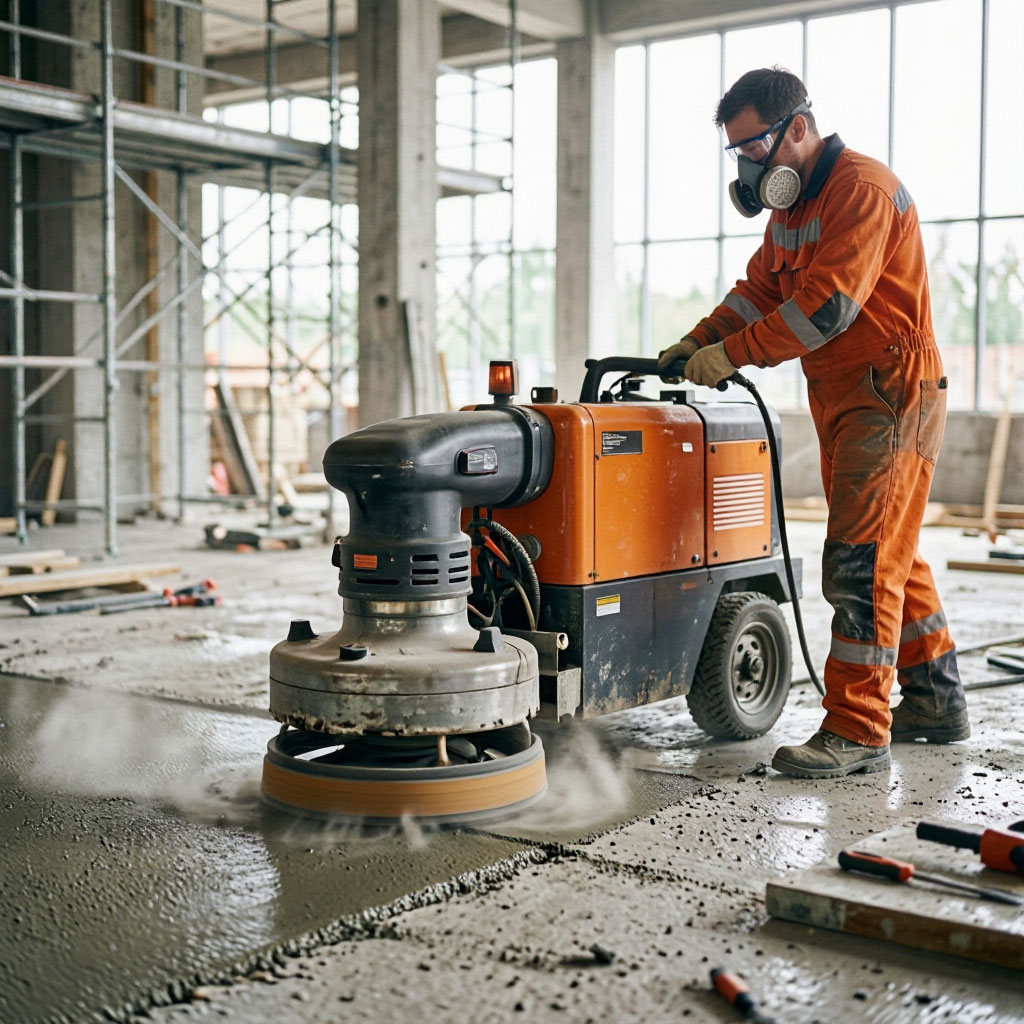
Dustless concrete surface preparation on site RIG 03 / DUSTLESS
99% Dust capture
H14 HEPA rating
375 CFM vacuum
[ INDUSTRIES & SPECIFICS ]

Different floors,
different requirements.

  • B / 01

    Warehouse & distribution

    Large open slabs, often power-troweled. Standard CSP 3–4 shot blast, then a high-build epoxy wear coat. Forklift traffic and racking point loads drive the coating spec, not the prep.

    CSP 3–4 · Standard blast
  • B / 02

    Food & beverage processing

    Washdown areas, thermal shock zones, drains. Urethane cement is the usual coating. Prep often has to happen overnight or during sanitation windows — dustless rig standard. Trowel-applied coving at wall junctions.

    CSP 4–6 · Dustless
  • B / 03

    Parking structures

    Driving decks, ramps, stair towers. Traffic membrane systems require careful profile control and often full-width shot blast for uniformity. Sloped decks and drain detailing add complexity.

    CSP 3–5 · Standard blast
  • B / 04

    Pharmaceutical & clean room

    Highest cleanliness standards. Dustless with added air scrubbing, negative-pressure containment, and post-blast particle counts. Full documentation package for the client's quality department.

    CSP 3–5 · Dustless + scrubbing
  • B / 05

    Retail & commercial

    Showrooms, restaurants, and lobbies. Often decorative finishes — polished concrete, stained concrete, metallic epoxy. Profile spec depends heavily on the finish system, which we coordinate with the designer.

    CSP 1–3 · Grinding + polish
  • B / 06

    Automotive service bays

    Oil, coolant, brake fluid, and hot tire pickup — the coating has to resist all of them. Prep removes all surface oils first, then blasts to CSP 4–5 for a high-solids epoxy system with a urethane topcoat.

    CSP 4–5 · Standard blast
  • B / 07

    Breweries & distilleries

    Wet, hot, acidic, slippery. Urethane cement mandatory in most production areas. Sloped floors to drains require careful edge work where the blast rig can't reach. Dustless during operation.

    CSP 4–6 · Dustless
  • B / 08

    Data centers & electrical rooms

    Occupied 24/7. Dustless rig mandatory. ESD-rated coatings installed over a CSP 2–3 profile — delicate balance between enough profile to bond and enough smoothness to preserve the ESD specification.

    CSP 2–3 · Dustless ESD
[ FAQ — CONCRETE ]

Questions we get
about concrete prep.

FULL FAQ →
Q / 01 How long does new concrete need to cure before it can be coated? +

Thirty days minimum, four months preferred, and the "right" answer is: as long as it takes to test below the moisture threshold the coating requires. Fresh concrete goes through a hydration phase where free water is still being consumed and diffused. Coating a slab that's still curing traps that water under the coating. For industrial slabs poured on a properly detailed vapor barrier, we can usually coat at the 60-day mark. Slabs poured without a vapor barrier may need 6+ months of drying, or a moisture mitigation system.

Q / 02 Can you prep over an existing coating? +

Yes, if the existing coating is sound and bonded. We blast through the old coating to profile the concrete underneath while leaving the coating in place — this is called "blast-through." If the existing coating has adhesion loss, blistering, or comes up in sheets, it has to come off first with scarifying or grinding, and the slab gets profiled from bare concrete. The decision is made by a pull-adhesion test on several spots before we quote.

Q / 03 What's a curing compound, and why does it have to come off? +

A curing compound is a film-forming sealer applied to fresh concrete to slow the evaporation of water during the hydration phase. Without it, the top millimeter of concrete dries faster than the rest and creates a weak, dusty "laitance" layer. That's the good news — the bad news is that the curing compound itself is designed to prevent things from bonding to the concrete. Any coating applied over an unremoved curing compound will peel. The most common first symptom is bond failure between the coating and the slab, and the fix is always the same: remove the curing compound and start over.

Q / 04 My slab has cracks. Can that be fixed during prep? +

Yes. Cracks are treated during the coating process, not during the prep — but the prep reveals which cracks are active and which are stable. Stable cracks are filled with a semi-rigid epoxy or polyurea after blasting; active cracks (still moving) require a flexible filler that accommodates movement. Cracks wider than about a quarter inch usually get routed out to a uniform width before filling. All crack repair is included in the coating quote, not the prep quote.

Q / 05 How do I know if my floor needs dustless prep? +

Simple question: can you shut the space down completely for the duration of the blast, or does the area need to stay functional? If it stays functional, or if the surrounding area is occupied, or if there's food or sensitive equipment nearby, dustless is the answer. The additional cost is roughly 15–25% over a standard blast. That premium almost always pays for itself in avoided shutdown cost and cleanup.

Q / 06 What's the difference between shot blasting and grinding? +

Shot blasting throws steel shot at the slab at high speed, creating a uniform CSP 3–8 profile across the surface. Grinding uses diamond-embedded discs to abrade the surface, producing a lower CSP 1–3 profile. Shot blasting is faster on large open slabs and produces a more uniform result. Grinding is used for edges, thresholds, tight areas where the blast rig can't reach, and for light-profile jobs where the coating spec calls for CSP 2 or less.

Q / 07 Can you blast a slab with a moisture problem and just coat over it? +

Not responsibly. If a slab is passing moisture vapor above the coating manufacturer's threshold, the coating will fail — usually within 12–24 months, often sooner. Two legitimate options: install a moisture mitigation system (a two-coat 100%-solids epoxy barrier) before the wear coat, or switch to a cementitious urethane system that tolerates higher substrate moisture. We'll quote either if it's what the slab needs. What we won't do is coat an over-threshold slab as if the problem doesn't exist.

Q / 08 How long does the prep itself take? +

Rule of thumb for shot blasting: a single rig covers 15,000–25,000 sq ft per shift depending on coating removal and edge work. A 40,000 sq ft warehouse slab typically takes 2–3 days of prep before coating starts. A small commercial space under 2,000 sq ft is usually a single day. Small rooms, edges, and details add time disproportionately because the rig can't fit — grinding handles those areas and is much slower per square foot.

[ NEXT STEP ]

Send us the slab.
We'll send back a spec.

Tell us the square footage, the current surface condition, and what finish you're planning to apply. If there's a coating spec from the manufacturer, send it — we'll blast to that CSP grade. If there isn't, we'll recommend one based on service environment and traffic.

Or email [email protected] — photos of the existing floor are helpful.